

Is Your Social Messaging Authentic? More Importantly… does AI Think So?
TL;DR:
AI is taking over search. What it’s looking for is authenticity, which it defines largely by applying the E-E-A-T framework: Experience, Expertise, Authoritativeness, and Trustworthiness. Here’s a way to achieve all four of those things and get positive citations for your brand in AI-powered results.
Let’s move past wondering whether your audience can be fooled by cheap and quick AI-generated content. If authenticity is important to your brand, my advice is, don’t go that route!
The tables have turned. As most of you have probably noticed, AI is now taking over search. Surprisingly or not, one of the primary signals it’s looking for is authenticity. And it’s getting pretty smart at finding it.
If you’re not careful, AI is going to E-E-A-T your lunch.
That acronym stands for Experience, Expertise, Authoritativeness, and Trustworthiness, which is a framework for measuring the quality of content in search results. It’s especially important for what Google calls, “Your Money or Your Life” topics, such as OTC and personal health care. AI is becoming very adept at seeking out those factors and applying the E-E-A-T framework to your brand’s messaging.
Face it: Today’s savvy consumers can sniff out an AI sales pitch faster than a pig on a truffle. However, they’re very comfortable letting AI do the slog work finding what they want on the internet. Pew Research determined in a 2025 study that 26% of searchers don’t click on any results below the AI Overview. Optimizely found that almost a third of consumers have made an online purchase “based solely on an AI-generated response.” Meanwhile, the use of AI search engines like Perplexity is growing exponentially.
“What used to be a straight line – search → click → website – has become uneven. AI summaries … often deliver the information that users want,” says Marketing Tech News.
How important is this really? According to Yext, a platform that helps brands focus on AI-driven searches, “Adhering to Google’s E-E-A-T framework is essential for visibility in AI-powered search. It’s not just about having great content; your brand needs to show clear signals of credibility.”
Strong Presence in AI-enabled Search
So, the key question becomes, how do you maintain strong presence in AI-enabled search by establishing an aura of Experience, Expertise, Authoritativeness, and Trustworthiness around your brand?
Let’s look at those factors one-by-one and see what they mean in brand terms.
Experience means that relevant information about your brand is grounded in actual experience, by real people who’ve used your product or service. For instance—honest, legitimate reviews.

Expertise elevates the factor of experience by focusing on users who’ve demonstrated subject knowledge. Typically, this is people who are seen to be members of an engaged community that has an intimate connection with the category.
Authoritativeness refers to the source, such as a website or social media account, that’s recognized as a go-to knowledge base with an audience who respect it for reliable information.
Trustworthiness implies that your brand is responsive to the needs of its consumers, hears their concerns, and consistently lives up to its brand promise.
Sounds like a tall order, eh? The good news is that, if you’re committed to authenticity in your brand messaging, there are ways to achieve all four of these things.
Combine Targeted Sampling with Reviews
An effective method for putting all the pieces together is to engage with a platform that combines targeted product sampling with in-home reviews. Prime examples of this would be Butterly, Peekage, and Social Nature.
Butterly bills itself as, “a community-powered product testing and consumer insight platform… [which] connects brands with a national community of Advocates who test products at home and share experience-based feedback grounded in everyday use.”
Bingo. Right there, you can see that you have an opportunity to hit all the buttons.
What happens in practice, is that a brand marketer will commit to providing a quantity of samples and define the profile of its ideal users. The Butterly team then selects a cohort of advocates, based on both their interest in the product category and their member profile, and executes a program to distribute the samples and encourage the selected participants to publish reviews within a reasonable length of time. Participants are under no obligation to provide positive reviews; the point is just honest and authentic feedback.
Natural Language & Candid Assessment
Butterly conducted a study titled The 2026 Trust Index Report, that surveyed over two thousand Canadian members of their Advocate program. Among its findings, it stated, “Authentic feedback is not performative or polished; it is honest, balanced, and grounded in real use. [It] is characterized by natural language, specific examples, and candid assessment.”
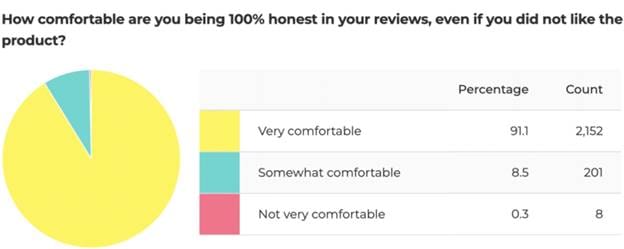
The quality of the selection process is critical. Butterly, in particular, states that, "every Advocate application is reviewed individually by a human, one by one."
An important factor is that participating members of the advocate community tend to be very adept at social media. Most of them are in effect, micro- or nano-influencers with engaged followers of their own. The reviews they provide are published to their own social accounts on platforms like Instagram, Facebook and TikTok, where they are seen by the reviewers’ followers. This often leads to shares, comments and likes, further boosting the spread of the content.

As an agency-customer of Butterly I can attest that the campaigns we’ve executed on their platform for our agency’s clients and their brands have been highly successful and beneficial, in both providing online presence and in gaining new fans. Insights seen in Facebook and Instagram have demonstrated significant gains vis-à-vis competitive brands.
Other platforms will of course yield similar results. Social Nature is another with which I’ve had personal experience and recommend highly. As the name implies, they focus exclusively on natural health and wellness products. Among their solutions they emphasize digital sampling, shopper insights and product reviews.
Community Validation Beyond Your Site
But wait, some of you are saying, how does this improve the rankings of my own website? Well, not as directly, perhaps, as the old model of keyword-based SEO. Like it or not, the new reality is less of a linear approach to driving traffic to your website, and more about surfacing your brand in places that consumers trust.
An analysis by AirOps of over 5.5 million AI-enabled searches concluded that, “User-generated content and community platforms influence 48% of AI search results”
Those AI search results, however, are not simple links to branded websites. They are detailed answers to increasingly long-tailed questions, and they often cite brand names while making reference to off-site product reviews.
“A user might read your advice in an AI summary today, then visit your site directly next week after remembering your brand name,” says Search Engine Journal. “Owned content defines your story—who you are, what you offer, and why you’re credible—and visibility in AI search grows when that story is reinforced through community validation beyond your site.”
“These conversations, shared experiences, and peer learnings that happen across community and UGC sites serve as public proof of trust, shaping what both users and models recognize as credible.”
The context may be different, but the impact can be more powerful because the searcher sees it more as helpful recommendation than as branded promotion.
Connecting to Your Brand’s Community
The bonus in following this approach is that it doesn't just work by surfacing your brand in AI-powered search; your brand’s consumer audience responds to these signals as well, whether they encounter them on your branded site or on their favourite social platform.
Brands are living things, and what gives them life is the community that’s built around shared values with the brand. That is why presence and engagement in social media is so important.
Through the process of in-home trial, honest reviews, and open sharing of brand insights, brands can achieve, “advocacy that is credible to both people and machines.”
To quote the Trust Index Report again, “Consumers provide higher-quality insight when … participation feels meaningful rather than transactional. Butterly participants view feedback as a form of collaboration rather than obligation.
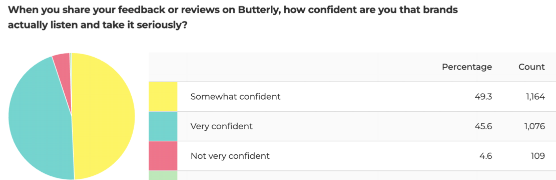
A line from the report is very telling: “More than three-quarters of respondents (79%) report feeling either strongly or somewhat connected to a brand's community.”
Another question arises: Is this in-home trial content equivalent to the reviews your product might get on an eCommerce platform? Is there a qualitative difference?
Without doubt, eCommerce reviews are an important signal for your brand. In its annual customer experience research, Forbes found that “85% of U.S. customers say ratings and reviews help them decide if they want to make a purchase.” Much has been written about how to encourage customer reviews, and I fully endorse that activity. However, there are significant differences.
One key differentiator is that eCommerce reviews are often related to issues like delivery times or in-transit damage, not necessarily the product itself. Another difference is that eCommerce reviews lack the sense of community; they carry less weight because they are not coming from a source of authority in the specific category.
Then, there’s the issue of trustworthiness. In the same customer experience research noted above, Forbes says, “that same number of customers (85%) also believe that some ratings and reviews are fake.”
The upshot is that, while you should encourage eCommerce reviews where possible, they are not the whole answer. Reviews based on sampling and in-home trial by qualified advocates should also be part of your picture.
Start Thinking Like AI
I've suggested here an approach that I know from experience can be very effective. But it is, of course, not the only approach.
The important point to remember is that search is changing, and AI-powered search is becoming more dominant by the day. There are many things you can, and should, do to maintain your brand's presence in this new world, in which consumers are expecting summarized answers, not just URL links.
In this new world, authenticity is not necessarily what you think it is, it's what AI thinks it is.
In short, as marketers, rather than waiting for the day that AI thinks just like us, (which may be coming sooner or later) we need to start thinking like AI.
Do you want suggestions on other ways to win citations in AI-powered search? Read my piece on UGC here, and watch this space for more on how to harness the power of User Generated Content (UGC).
And of course … If you found this interesting or even inspiring, please follow me on LinkedIn.